In many software projects, the SRS is the most important document nobody wants to read carefully. Clients skim it because it looks technical. Project teams move past it because everyone is eager to start building. Then, weeks or months later, a disagreement appears: that feature was assumed, this workflow was misunderstood, or the reporting logic never meant what one side thought it meant.
This is exactly why the software requirements specification matters. It is the reference point that translates business intent into buildable scope. IBM describes requirements management as the discipline that helps teams document, analyse, agree on, and trace requirements so the end product meets expectations while reducing risk and cost. That is the practical role of the SRS in a custom software project.
If the SRS is vague, the project will eventually become vague too. The confusion just shows up later, when fixing it is more expensive.
What an SRS actually does
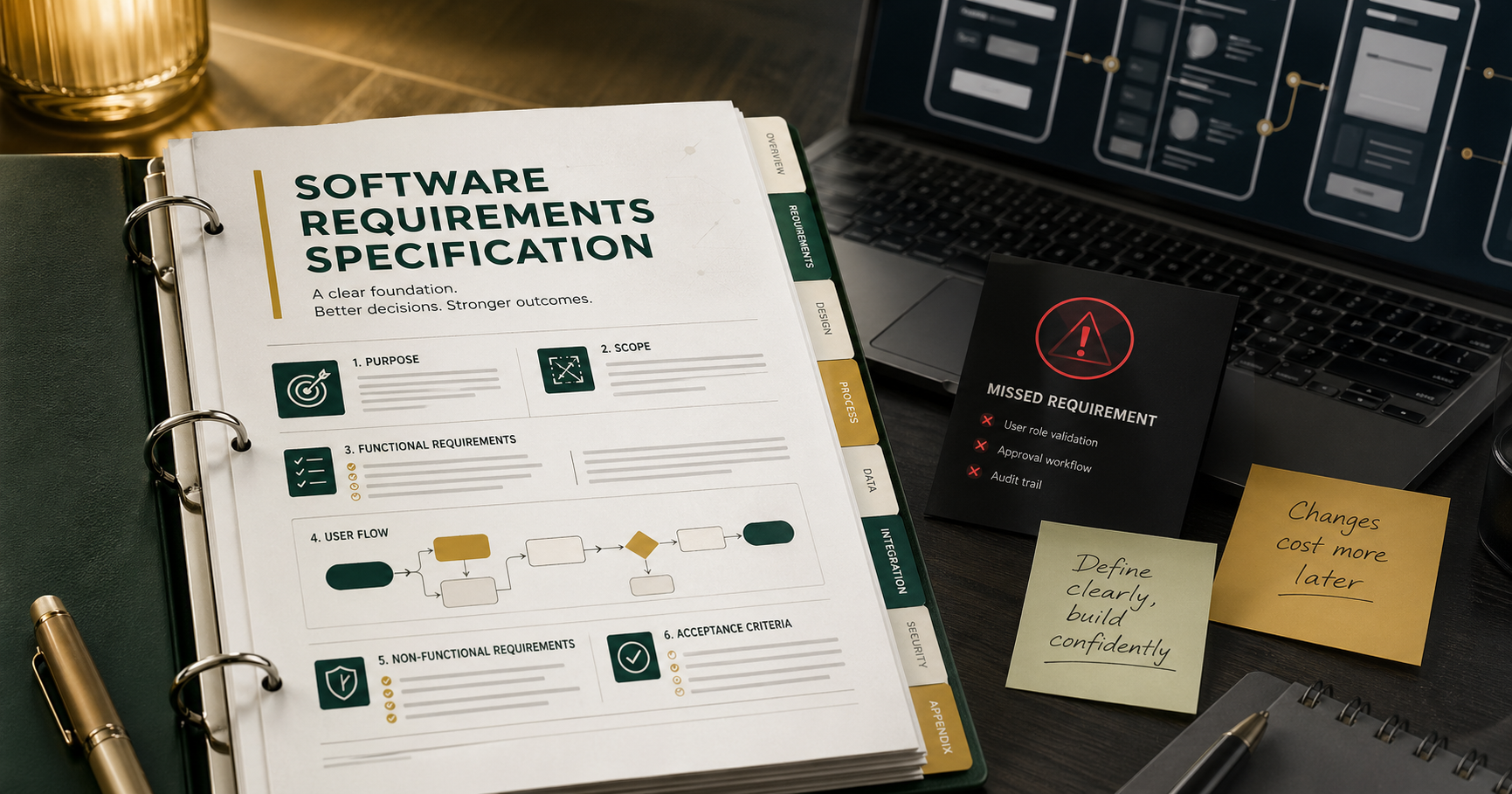
A software requirements specification is not just a list of features. It is the structured description of what the system must do, how users will interact with it, what constraints matter, and what success looks like. A good requirements document gives the project shared language before development starts.
In practical terms, the SRS helps define:
- The business problem the system is solving
- The user roles involved and what each role can do
- The workflows, edge cases, and approval logic
- The integrations, data rules, and constraints
- The boundaries of scope and what is not included
That last point matters more than most people expect. Clear exclusions are often what prevent later arguments about assumptions.
Why businesses only care about the SRS after something breaks
The SRS usually becomes important at the exact moment someone needs proof of what was agreed. That might happen when a feature is missing, when a workflow behaves differently than expected, or when a change request is raised and one side believes it should already be in scope.
At that point, the project goes back to the document everyone previously treated as a formality. If the SRS is strong, it becomes the anchor for decision-making. If it is weak, the team ends up negotiating from memory, assumptions, and incomplete notes.
IBM’s requirements guidance also highlights traceability as a core benefit. Once requirements are linked to design, testing, and implementation, teams can make changes more safely and understand what impact those changes have. That is much harder when the original SRS is thin or poorly structured.
What poor SRS quality actually costs
Research published through IBM Research found meaningful links between requirements specification quality and project success or failure. In simple terms, weak requirements quality was associated with project overruns. That aligns with what most delivery teams see in practice: the less precise the early requirements are, the more rework appears later.
When the SRS is weak, the cost usually shows up in familiar ways:
- Scope creep disguised as misunderstanding
- Features built correctly against the wrong assumption
- Extra rounds of clarification after development already started
- Delayed testing because expected behaviour was never fully defined
- Tension between client and vendor over what was or was not agreed
None of those problems are purely technical. They are requirements problems.
What a good SRS should contain
A strong SRS does not need to be unreadably dense. It needs to be clear enough that both business stakeholders and delivery teams can rely on it. At minimum, a good software requirements document usually covers:
-
1Project objective and business context. Why the system exists, what problem it solves, and what outcome matters most.
-
2User roles and permissions. Who uses the system and what each user type is allowed to do.
-
3Functional requirements. The features, workflows, and logic the system must support.
-
4Non-functional requirements. Performance, security, reliability, access control, hosting, or compliance constraints.
-
5Integrations and data rules. How the system connects to other tools, what data comes in or out, and what format or dependencies matter.
-
6Assumptions, exclusions, and edge cases. What is not included, what depends on the client, and what scenarios need special handling.
Why non-technical decision-makers should still read it
Many business owners and managers assume the SRS is too technical to be worth reading. But the most important parts are usually not deeply technical at all. They are the parts that define workflows, approvals, business rules, role permissions, reporting expectations, and process boundaries.
If you are approving budget or signing off on delivery scope, those are exactly the sections you should care about most.
That is also why a good SRS should not be written only for developers. It should be readable enough that the client side can validate whether the system described in the document is actually the system they want.
How to use the SRS properly before sign-off
The best way to use an SRS is not to admire it. It is to challenge it before development starts. Ask questions such as:
- Does this reflect how our process really works today?
- What happens in exception cases?
- Which role is allowed to approve, edit, or override this?
- Which reports or outputs are assumed but not described clearly?
- What is explicitly out of scope in this version?
Those questions are much cheaper before build starts than after code has already been written.
Where the SRS connects to the rest of the project
The SRS should not exist in isolation. It should shape the build plan, test scenarios, milestone reviews, and acceptance criteria. If a requirement cannot be traced forward into design, implementation, or testing, that is usually a sign it was never specified clearly enough.
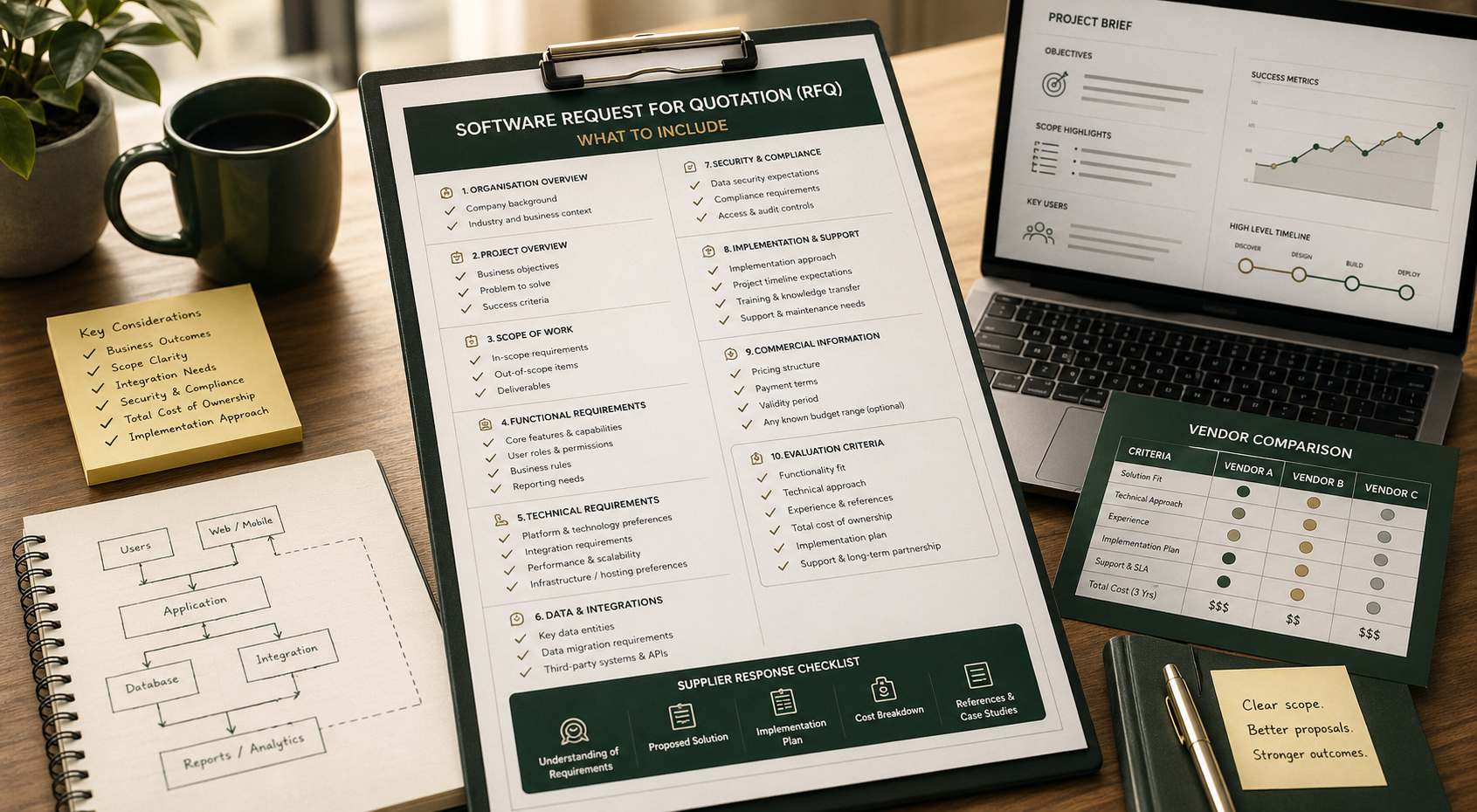
This is also why the SRS connects naturally to software RFQ quality. If your initial project brief is weak, the SRS often starts from weak assumptions too. That overlap is part of why we emphasise good scoping in our article on what to include in a software RFQ.
What the SRS really protects
A good SRS protects more than the vendor. It protects the client from buying ambiguity. It gives both sides a shared understanding of what success looks like, how scope is interpreted, and where change begins. That is not bureaucracy. That is delivery discipline.
Most people do not appreciate the value of the SRS until something goes wrong. The better approach is to use it properly before anything has the chance to go wrong at all.
This article provides general information only and should not be treated as legal, procurement, or technical advice. Every software requirements specification should be shaped by the business process, project risk, and delivery model involved.