Many Malaysian businesses say they need a software RFQ when they are really asking for something closer to a software RFP. That is normal. In practice, decision-makers use RFQ, RFP, proposal request, and project brief almost interchangeably. For custom software, the distinction matters less than one thing: are you giving vendors enough information to respond to the same problem?
If the answer is no, every proposal will come back looking different. One vendor will assume a lightweight portal. Another will assume enterprise workflow. Someone else will exclude integrations, migration, or training. The numbers will vary widely, but not because one vendor is expensive and another is efficient. They are simply quoting different scopes.
For off-the-shelf products, an RFQ may be enough. For custom software development, you usually need a stronger requirements brief so vendors can propose approach, scope, timeline, cost, and delivery risk properly.
Why weak software RFQs create bad buying decisions
A weak software RFQ creates confusion in three places. First, it forces vendors to make assumptions that are invisible to you. Second, it makes price comparison meaningless because proposals are not based on equivalent scope. Third, it shifts risk into the project after signing, where it shows up as change requests, delays, and frustration.
This is especially common when non-technical decision-makers are buying software for an operations problem. The business knows the pain is real, but the brief only says things like "need a dashboard", "need a system", or "need automation". Those are not requirements. They are outcomes you hope the software will achieve.
What to include in a software RFQ
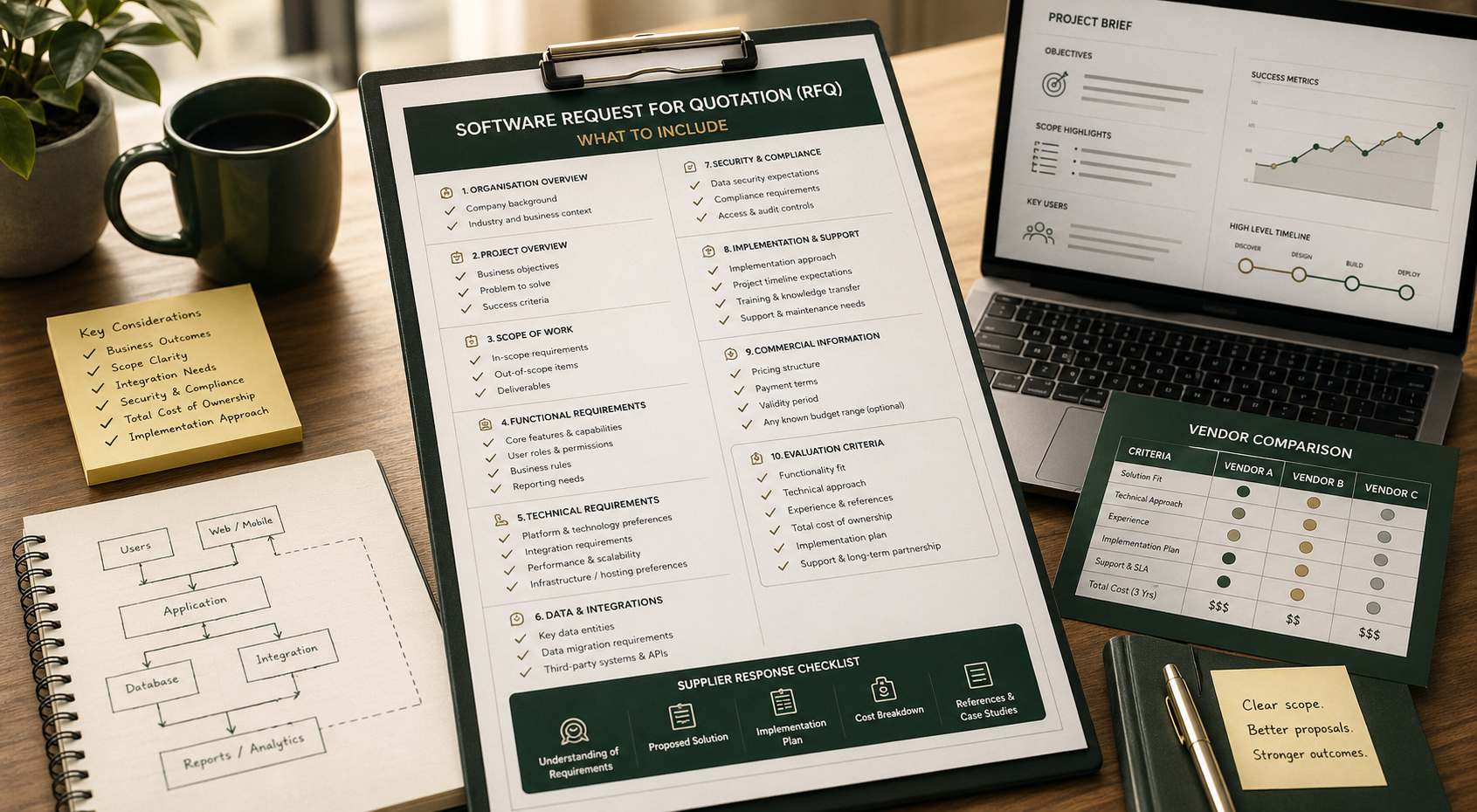
If you want clearer proposals and better software vendor selection, these are the sections worth including in your software RFQ or software RFP.
1. Business context and the real problem
Start by describing the business context in plain language. What does the company do? Which team is affected? What operational problem is driving the project? Is the issue delayed approvals, manual stock visibility, fragmented reporting, duplicated data entry, poor customer follow-up, or weak control across branches?
This section matters because vendors need to understand the commercial and operational objective before they recommend architecture or features. The better the business context, the better the proposed solution.
2. Who will use the system
Your RFQ should identify the main user groups. For example: HQ management, finance, outlet managers, warehouse staff, sales staff, customers, or external partners. If different users need different permissions or workflows, say so early.
Many custom software projects become more complex because user roles are discovered too late. A system with one type of user behaves very differently from a system with multiple departments, approvals, and access rules.
3. Current workflow and pain points
Do not just describe the desired future state. Include how the process works today. What tools are currently used? Excel? WhatsApp? Email approvals? An old system? Manual forms? Where does the delay or error usually happen?
This is one of the most valuable sections in a software development RFQ because it helps vendors understand whether they are replacing a tool, redesigning a process, or integrating multiple systems into one flow.
4. Scope of work and must-have features
List the functions you already know are essential. Separate them into must-have, good-to-have, and future phase. This makes the RFQ more realistic and helps vendors phase the work more effectively.
For example, a custom software RFQ might include:
- User login and role-based permissions
- Approval workflow and audit trail
- Dashboard and reporting by branch or department
- Integration with accounting, payment gateway, or ERP
- Data import from existing spreadsheets or legacy systems
- Mobile responsiveness or dedicated mobile app support
5. Integrations and technical environment
If the future system needs to connect to anything else, say it clearly. This includes accounting software, payment gateways, POS systems, CRMs, e-commerce platforms, APIs, SSO, internal databases, and reporting tools.
One of the most common reasons vendors submit different pricing is that some assume integrations are simple while others assume they require middleware, data mapping, authentication work, and testing. If you know the existing platforms, versions, or constraints, include them.
6. Data, security, and compliance requirements
This matters more in Malaysia than many buyers expect. If your system will handle personal data, employee records, customer transactions, or financial information, the RFQ should mention your expectations around PDPA, access control, backups, audit logs, hosting, and data retention.
In some projects, businesses also need to state whether hosting must remain in Malaysia, whether cloud providers are acceptable, what level of documentation is required for audit or finance review, and whether e-Invoicing or reporting processes will be affected.
7. Deliverables beyond the software itself
Many RFQs focus only on the final system and forget the surrounding deliverables. That is risky. For custom software projects, ask vendors to state whether the proposal includes:
- Requirements study or SRS
- Wireframes or UI mockups
- User acceptance testing support
- Training and onboarding
- Deployment and go-live support
- Source code ownership and handover
- Warranty period and post-launch support
If you leave those items out, some vendors will include them and others will exclude them. That makes commercial comparison harder than it should be.
8. Timeline expectations and decision process
Include your expected timeline, even if it is approximate. When do you want vendor responses? When do you want the project to start? Is there a target go-live window? Is there an internal event driving the timeline, such as a finance year-end, e-Invoicing readiness, operational expansion, or replacement of a legacy system?
Also state who will evaluate the proposals. If finance, operations, and IT all need to review, that helps vendors prepare a more useful response.
9. Commercial structure and budget signal
Many buyers avoid mentioning budget because they worry vendors will price to the ceiling. In reality, a total lack of budget signal often causes the opposite problem: proposals that are too broad, too narrow, or built on assumptions that waste time for everyone.
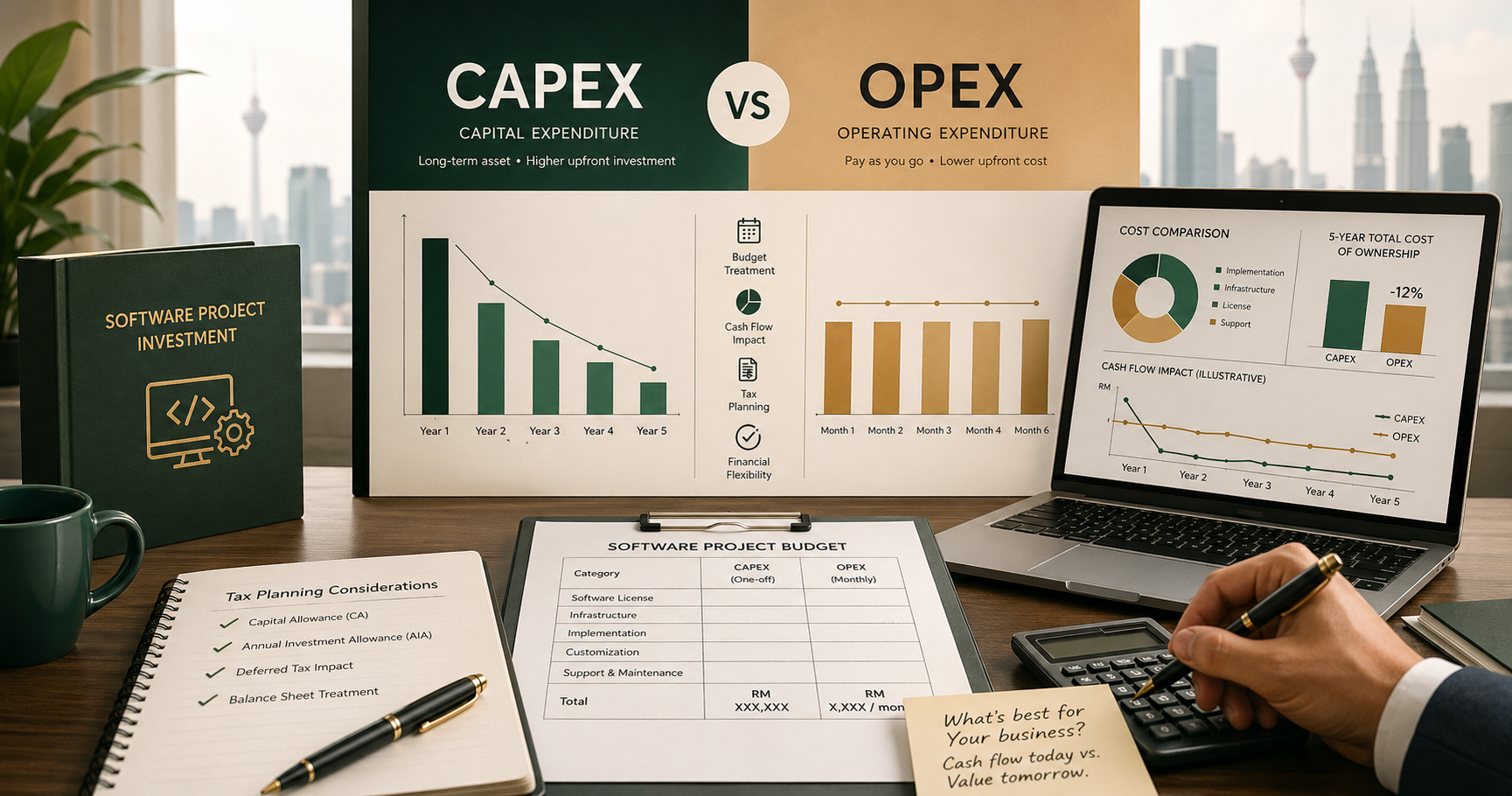
You do not need to publish an exact number. A range or commercial preference is enough. For example: phase-one budget range, preference for milestone-based CAPEX, or openness to managed-service OPEX structuring. That helps vendors design a commercially realistic response.
10. Evaluation criteria
If you want better vendor responses, tell vendors how they will be judged. Price is never the only factor in a successful custom software project. Your software vendor selection criteria may include:
- Understanding of the business problem
- Clarity of scope and assumptions
- Relevant project experience
- Delivery approach and change management support
- Security, documentation, and handover quality
- Commercial structure and ongoing support
What Malaysian businesses often forget to include
Based on common market patterns, there are a few gaps we see repeatedly in local software procurement briefs. These are the items that tend to surface late and create avoidable friction:
-
1IP ownership. Confirm whether source code, design files, documentation, and deployment assets are fully transferred at project completion.
-
2Testing and UAT expectations. State whether the vendor must support structured UAT, defect resolution, and sign-off before go-live.
-
3Training and support. Many proposals exclude training sessions, admin guides, or support response time unless you ask for them.
-
4Data migration. Moving old Excel files or legacy system data is not a small detail. It affects scope, testing, and project risk.
-
5Compliance and hosting constraints. If you have PDPA, audit, or internal IT restrictions, they should appear in the RFQ, not only after vendor selection.
A simple software RFQ structure you can use
If you want a practical format, a good software RFQ template usually includes these headings:
- Company background
- Project objective
- Current process and pain points
- User groups and departments involved
- Required features and scope priorities
- Integrations and technical environment
- Data, security, and compliance requirements
- Expected deliverables and documentation
- Timeline and response deadline
- Commercial structure or budget guidance
- Evaluation criteria
You do not need to write it like a technical architect. You just need to make the business reality clear enough that vendors can respond to the same problem.
The real purpose of a better RFQ
The goal of a software RFQ is not paperwork. It is risk reduction. A better RFQ helps you compare vendors properly, identify weak assumptions earlier, and avoid paying for ambiguity later. That matters even more when the buying team is non-technical, because the document becomes the bridge between business pain and technical delivery.
If your team is not ready to produce a detailed RFQ internally, that is not a sign the project should stop. It usually means the right next step is a requirements study first, followed by a stronger proposal brief. That is far cheaper than starting development with an unclear scope.
This article provides general information only and should not be treated as legal, procurement, or technical advice. Every software procurement process should be adapted to the business's size, industry, compliance requirements, and delivery risk.