Expertise and team strength
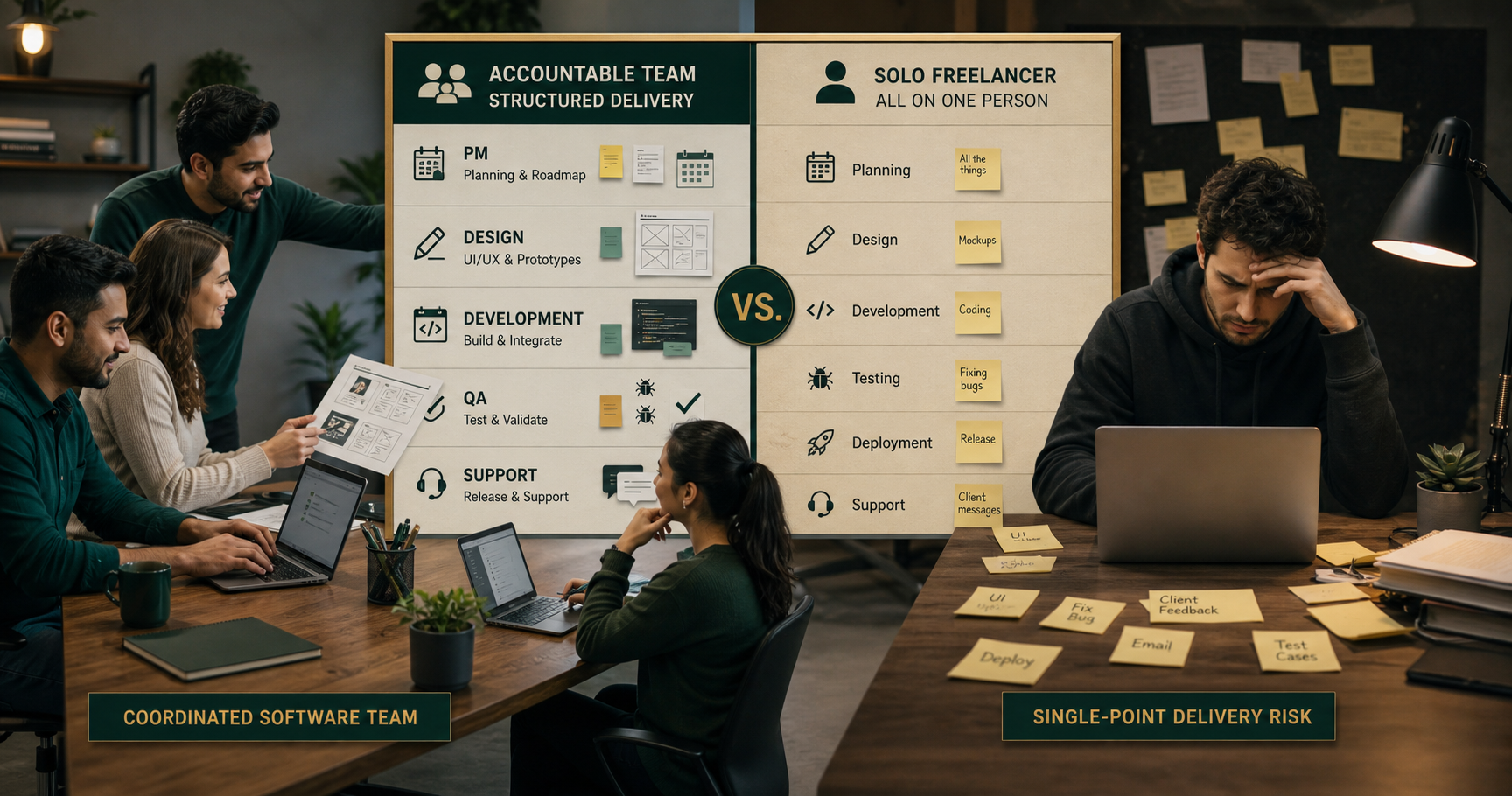
Software house. Engaging a software house gives you a full team of specialists — project managers, UI/UX designers, front-end and back-end developers, QA testers, and IT consultants. Every part of the project is handled by someone whose actual discipline it is, which typically means higher quality and faster, more reliable delivery.
Freelancer. A freelancer usually works alone. They may be genuinely strong in one or two areas, but a full project spans design, development, testing and deployment — so you often end up hiring several freelancers and stitching their work together yourself, with the coordination risk that creates.
Project management and communication
Software house. A professional software house provides structured project management: clear milestones, regular progress updates, defined scope, and dedicated support. You always know where the project stands and what happens next. That structure is exactly what keeps complex builds on track.
Freelancer. Freelancers manage their own time across multiple clients. Communication can be excellent — or it can go quiet at the worst moment. There is rarely a formal project-management layer, so the responsibility for keeping things on schedule tends to fall on you.
Quality, testing and reliability
Software house. Quality assurance is a built-in stage, not an afterthought. Dedicated testers catch issues before launch, and established processes mean the work is documented, maintainable and handed over properly.
Freelancer. Testing depends entirely on the individual's discipline and time. Some are meticulous; others ship and move on. Documentation is frequently thin, which becomes a real problem the day you need to change or extend the system.
Continuity and long-term support
This is where the gap widens most. A software house is an entity that persists — if one developer moves on, the team and the knowledge remain, and support continues. A freelancer is a single point of failure. If they get busy, take on a bigger client, or simply stop responding, your project — and its future maintenance — can stall with no fallback.
For any system your business will depend on daily, continuity is not a nice-to-have. It is the whole point.
Cost: the real comparison
Freelancers usually win on headline price, and for good reason — lower overhead. For a small, self-contained, one-off task, that can make them the sensible choice.
But headline price and total cost are different things. Factor in coordination time, rework from gaps in quality, the risk of a stalled project, and the cost of untangling poorly documented code later, and the "cheaper" option often costs more over the life of the system. A software house's higher upfront price frequently buys a lower total cost of ownership.
A simple way to decide
Ask yourself one honest question: if this breaks in a year, who fixes it? If the answer needs to be "a reliable partner who still has the knowledge and the team," you already know which way to lean.
The regional consideration
In both Malaysia and Singapore, the freelance market is deep and the quality varies widely. Vetting a freelancer properly takes real effort, and the risk falls entirely on you. A software house carries that risk instead — you are buying an accountable entity, a contract, and a team, not a single person's availability.
At Trendtive Digital, we operate as a full software house serving Malaysian and Singaporean businesses: a complete team of project managers, designers, developers and QA, delivering with structured management and long-term support. For business-critical systems — the ones you can't afford to have stall — that structure is exactly what protects your investment.